Airtightness Testing: From Design to Measured Performance
Air leakage is one of the most common causes of underperformance in new buildings—yet it often goes untested until after energy models are submitted, HVAC systems are commissioned, and certification deadlines are approaching. By that point, correcting it is difficult, expensive, and disruptive.
In projects pursuing certifications like Mostadam in Saudi Arabia or LEED v5, airtightness testing is no longer optional. It is a requirement for verifying that the building envelope actually performs to the standard set in the design phase. Consultants, project managers, and sustainability teams working across the GCC are now including اختبار التسرب الهوائي (airtightness testing) as part of their commissioning plans to avoid delays, meet compliance targets, and reduce long-term operating costs.

Our field engineers at Buildingdoctor often find that a small number of overlooked envelope details—poorly sealed MEP penetrations or loose window frames—can contribute disproportionately to a project’s overall energy leakage. That’s why we emphasize these checks early.
Why Airtightness Testing Matters?
Uncontrolled air infiltration contributes significantly to energy loss, especially in warm-climate commercial and residential buildings. According to a peer-reviewed study published in Energy and Buildings, air leakage can account for between 40% and 60% of thermal losses (Energy & Buildings – Elsevier). These losses are invisible to the eye but have a measurable impact on HVAC sizing, pressurization, and occupant comfort.

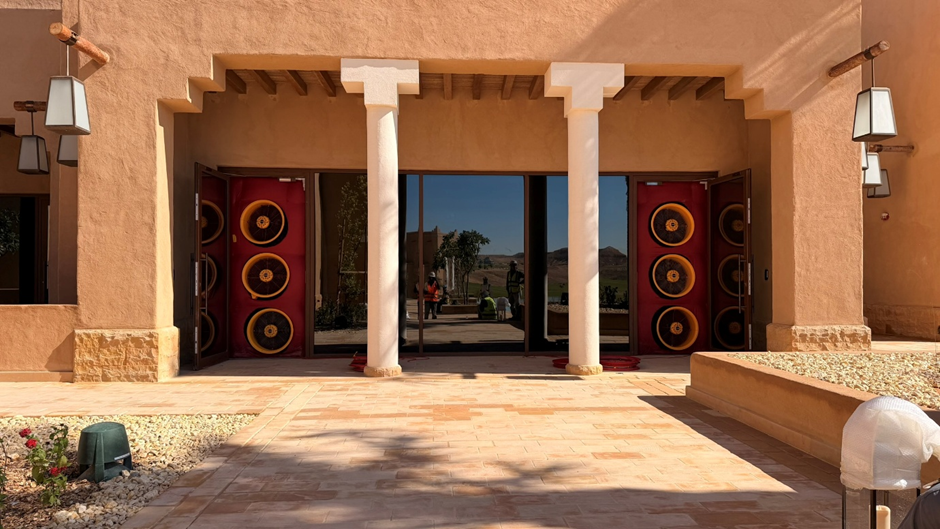
Airtightness is measured through blower door testing, with results typically expressed as m³/h/m² @50Pa (air leakage rate) or ACH50 (air changes per hour at 50 Pascals). These figures are now required under multiple frameworks, not as theoretical estimates but as post-construction requirements. To support accurate testing and diagnostics, teams often use اختبار الدخان (smoke testing) to visually identify leaks and التصوير الحراري بالأشعة تحت الحمراء (infrared thermography) to locate thermal bridging or air leakage.
And as energy codes tighten across the region, this emphasis is no longer optional. Under frameworks like Mostadam, airtightness must be measured—not assumed.
Mostadam: Turning Policy into Post-Construction Proof
One of the clearest examples of how airtightness is being enforced in the region is Saudi Arabia’s Mostadam certification system. Developed under Saudi Vision 2030, it formalizes what many practitioners—ourselves included—have long identified: without verified envelope performance, energy models fall apart. The system outlines performance-based criteria across energy, water, materials, and indoor environment. Under the Energy Efficiency category, one of the key compliance items is Measure EE 5.3 – Building Envelope Airtightness. This refers to the requirement for calibrated testing after construction to prove that the building’s envelope meets Mostadam’s defined air leakage thresholds—ensuring real-world energy performance, not just design intent.
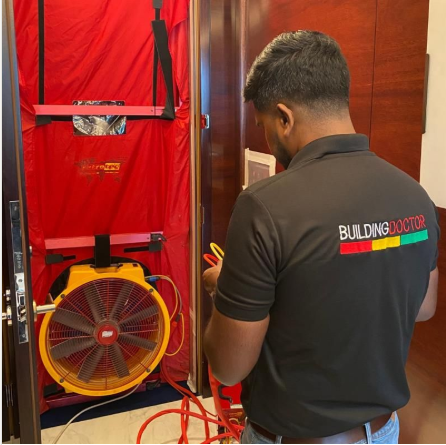
This requirement appears in the Mostadam Technical Manual and mandates that each project conduct a calibrated post-construction airtightness test (referred to in Arabic as الاختبار بعد الإنشاء) using standardized methods. Projects seeking Certified, Silver, or Gold ratings must submit test results confirming that envelope leakage is within the allowable limits defined in Mostadam’s building typology tables.
The technical manual states:
“The project shall demonstrate that the building envelope limits air infiltration below the threshold defined in the Mostadam Building Typology Table.”
(Source: Mostadam Manual – SEEC (Arabic))
If the envelope does not meet these targets, the project cannot proceed to final certification—even if energy modeling has already been approved.
Buildingdoctor’s Mostadam-compliant testing protocols are designed specifically to align with Measure EE 5.3 and its thresholds, helping project teams avoid delays during the final documentation phase.
LEED v5: From Design Assumptions to Measurable Outcomes
Where Mostadam enforces airtightness in a regional context, LEED v5 reflects the same shift on a global scale—rewarding teams for real-world performance, not design intent. Under LEED v5, airtightness testing plays a role in several key Energy & Atmosphere and Indoor Environmental Quality credits. According to the U.S. Green Building Council:
“LEED v5 reinforces accountability by rewarding actual performance, moving beyond design intent.”
(Source: USGBC – LEED v5 Overview)

Testing supports LEED credits including:
Minimum Energy Performance (EAp1)
Optimize Energy Performance (EAc2)
Enhanced Indoor Air Quality Strategies (IEQc1)
By submitting blower door results, project teams can document reduced infiltration rates and validate the assumptions used in their energy models.
We’ve worked with multiple LEED projects where blower door testing helped close the gap between modeled energy use and field results—ultimately securing those critical performance points.
GCC Projects Are Closing the Envelope Performance Gap
As of late 2024, Masdar City’s “The Link” project—a five-building development anchored by CO-LAB—set new benchmarks for airtight, high-performance design. The project aims to achieve LEED Platinum and Zero Energy certification from the International Living Future Institute. CO-LAB, its shared work-and-living hub, is designed to reduce energy use by 117% compared to international baselines and produce 135% of its own energy from renewable sources. These goals reinforce the growing role airtight envelopes play in closing the gap between modeled and real-world energy performance in the region (RIBA Journal, 2024).

As part of Dubai’s shift toward performance-verified energy management, Etihad ESCO integrated blower door testing and envelope sealing into retrofit projects across multiple public-sector buildings. The upgrades—conducted under the city's first Energy Savings Performance Contract (ESPC)—included DEWA facilities in Al Hudaiba, Umm Ramool, Al Wasl, and Burj Nahar. According to Etihad ESCO’s official release, the project led to 35.2 GWh in electricity savings and a reduction of 1,452 tonnes of CO₂ emissions over six years. These outcomes highlight how airtightness interventions directly contribute to operational efficiency and verified energy performance.
Source: Etihad ESCO announcement (2024), via DEWA
The lessons from these high-profile projects mirror what we see across smaller residential and mixed-use developments: without airtightness verification, performance modeling falls short.
Timing and Risk
Airtightness testing is most effective when conducted immediately after envelope closure but before internal finishes, ceilings, partitions, or finishes are installed. At this stage, leaks can be sealed efficiently, and pressure testing can confirm improvements. Testing late in the project often results in access limitations, higher costs, or certification delays.
We consistently advise project teams to plan for mid-stage testing—just after façade and fenestration installation—so any failures are fixable without cost blowouts or program shifts.
Knowing why airtightness matters is only half the equation. Knowing when to test can make or break certification timelines.
In practice, involving airtightness specialists like Buildingdoctor earlier in the process—not just at the testing phase—can help project teams identify design-stage risks, prepare for performance verification, and reduce the likelihood of rework. Early input supports better envelope detailing and more consistent test results.
Cost and Lifecycle Impact
Although it represents a small portion of project cost—typically less than 0.02%—airtightness testing has a large impact on long-term energy use. According to the International Energy Agency, building envelopes account for 40–60% of operational energy performance in most building types (IEA Report).
Verified airtightness also reduces the risk of HVAC oversizing, supports thermal comfort, and improves humidity control and indoor air quality—all of which are relevant to compliance and post-occupancy success.
Buildingdoctor’s Role in Performance Validation
Buildingdoctor supports consultants, project managers, and contractors in achieving verified building envelope performance using Retrotec blower door systems aligned with ATTMA TSL1, Mostadam, and LEED v5 protocols. Our process goes beyond test results. We integrate field testing with site evaluations, diagnostic tools like اختبار الدخان (smoke testing) and التصوير الحراري (thermal imaging), and engineering reviews to provide actionable recommendations.
Our services are designed to:
Verify compliance with Mostadam Measure EE 5.3
Support LEED v5 performance-based credit submissions
Assist in Estidama and Al Sa’fat building envelope documentation
Provide pre-handover or third-party testing during commissioning
This work has supported clients across the GCC in avoiding rework, securing certification, and ensuring that energy savings aren’t just projected—they’re proven.
Our team works closely with construction and sustainability teams to schedule tests at the right time, avoid rework, and meet submission timelines. Whether the project is a villa, residential and commercial buildings, communities, data centers, or industrial buildings, we adapt to the technical and certification requirements of the region.
Conclusion
Airtightness testing is not just a box to tick. It is a technical requirement tied to certification, operational cost, and building performance. With Mostadam and LEED v5 moving toward verified outcomes, the gap between what is modelled and what is built must be measured—and closed.

At Buildingdoctor, we don’t just test—we help close the loop between design targets and built performance. By working directly with site teams, we verify that what was promised on paper is actually delivered in the field.
Have questions or need consultation for Airtightness test? Connect with us:
📞 +971 (0) 455 17140