
Bridging the Gap: From Prescriptive Compliance to Measured Building Performance in Saudi Arabia
Saudi Arabia’s sustainability agenda under Vision 2030 has accelerated the adoption of energy-efficient building practices across the Kingdom, particularly within the built environment where buildings account for a significant share of national electricity demand. Cooling loads driven by the region’s hot-arid climate represent a major portion of electricity consumption in Gulf countries. Studies focusing on the Saudi residential sector indicate that cooling demand dominates building electricity consumption due to extreme climatic conditions (Alrashed & Asif, 2014; Krarti et al., 2017).
Regulatory frameworks such as the Saudi Building Code (SBC 601) and sustainability initiatives including Mostadam increasingly emphasize improved building envelope performance and reduced operational energy consumption (Ministry of Municipal and Rural Affairs and Housing, 2021). To verify that buildings achieve these targets in practice, standardized testing methodologies are increasingly applied. Internationally recognized testing methodologies such as ISO 9972, ATTMA Technical Standards TSL1 and TSL2, and ASTM E779 are used to measure building envelope airtightness and verify envelope performance (ASTM International, 2018; International Organization for Standardization, 2015; ATTMA, 2016).

Research across global building markets has identified a persistent difference between predicted and measured building energy performance, commonly referred to as the building performance gap (de Wilde, 2014).
While design modelling plays an important role during the design stage, project teams responsible for delivering high-performance buildings must verify performance through field testing and measured diagnostics.
From Compliance to Measured Performance
Despite these regulatory and sustainability initiatives, an important question remains within the construction sector: are high-performance buildings consistently delivering measurable operational outcomes, or are they primarily achieving compliance through prescriptive design checklists and modelled assumptions?
As sustainability targets become more ambitious, the distinction between design intent and measured performance becomes increasingly important for verifying the effectiveness of building energy strategies.
The Performance Gap in Cooling-Dominated Climates
Energy modelling tools are widely used during the design stage to estimate building energy consumption and demonstrate compliance with sustainability frameworks. However, several studies show that operational energy consumption often differs from predicted values (de Wilde, 2014; Menezes et al., 2012).
In cooling-dominated climates such as Saudi Arabia and the wider GCC region, building envelope performance plays a particularly significant role in determining energy use. Air leakage through façade joints, window interfaces, and other elements of the building envelope allows warm outdoor air to infiltrate conditioned spaces, increasing cooling loads and reducing HVAC efficiency (Sherman & Chan, 2004). Experimental research in UAE residential buildings has shown that improving airtightness through targeted sealing strategies can reduce annual energy consumption by approximately 3% (Taleb, 2022).

For professionals responsible for delivering energy-efficient buildings in Saudi Arabia, understanding how constructed buildings perform in practice—rather than relying solely on design assumptions—is essential for improving building energy efficiency.
Limitations of Prescriptive Compliance
Historically, many building regulations and sustainability certification systems relied on prescriptive compliance approaches, where projects demonstrate conformity with defined construction methods or design strategies (Bordass & Leaman, 2013).
While prescriptive requirements provide useful guidance during design and construction, they primarily focus on documentation rather than measured operational performance. A building may comply with regulatory requirements based on modelled performance without verification that the completed building performs as intended (de Wilde, 2014).
Studies comparing predicted and measured building performance frequently report deviations ranging from 20–50% between modelled and actual energy consumption (Menezes et al., 2012).
Envelope-Driven Energy Losses and Verification Requirements
Building envelopes play a critical role in determining thermal and energy performance in hot climates. Air infiltration through façade interfaces and window systems allows hot outdoor air to enter conditioned spaces, increasing cooling loads and reducing HVAC efficiency (Straube & Burnett, 2005).
For engineers and consultants responsible for building envelope performance, standardized testing methodologies provide a reliable way to quantify air leakage through controlled pressurization tests. Whole-building airtightness testing is commonly conducted using procedures defined in ISO 9972, ATTMA Technical Standards TSL1 and TSL2, and ASTM E779, which measure air permeability under controlled pressure differences.

Across projects in the GCC region—including developments where Buildingdoctor provided envelope testing and diagnostic support—field verification programmes have shown that façade detailing, construction sequencing, and workmanship variability can significantly influence final airtightness performance.
Emergence of Measured Diagnostics in Saudi Construction
As sustainability frameworks evolve, project teams across Saudi Arabia are increasingly expected to demonstrate performance through measurable diagnostics rather than relying solely on design simulations.
Experimental studies in Gulf residential buildings have demonstrated the effectiveness of blower door testing combined with thermography to identify envelope leakage pathways and quantify improvements in airtightness performance (Taleb, 2022).
Airtightness testing has become one of the most widely used diagnostic tools for evaluating envelope integrity. Industry guidance published by the Air Tightness Testing and Measurement Association through ATTMA Technical Standards TSL1 and TSL2 provides standardized methodologies for measuring building envelope airtightness (ATTMA, 2016).
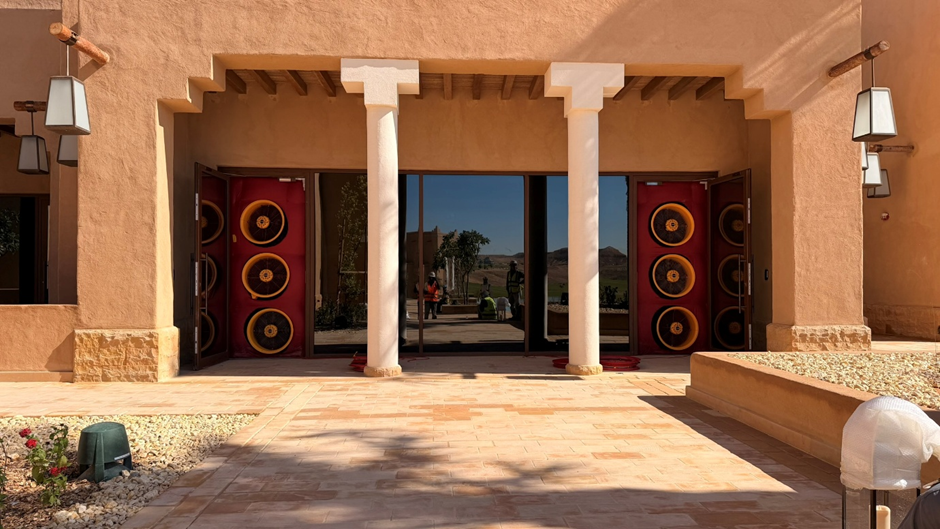
Measured diagnostics such as airtightness testing, thermographic inspections, and commissioning verification therefore provide an essential mechanism for validating building performance after construction.
Integration with Mostadam
The Mostadam Green Building Rating System represents an important step in improving sustainability performance across Saudi Arabia’s construction sector (Ministry of Municipal and Rural Affairs and Housing, 2021).
Diagnostics such as airtightness testing, commissioning verification, and thermographic inspections provide valuable evidence that buildings meet intended sustainability objectives.
Experience from projects across the GCC region—including developments where Buildingdoctor supported airtightness verification during commissioning—suggests that integrating performance diagnostics during construction stages can help identify envelope deficiencies before buildings become fully operational.
Evolution of Sustainability Frameworks in Saudi Arabia
Over the past decade, Saudi Arabia has made significant progress in integrating sustainability principles into the construction sector through Vision 2030 initiatives, updated building regulations, and national sustainability programmes.

Regulatory frameworks such as the Saudi Building Code, together with sustainability initiatives including Mostadam and the Saudi Green Initiative, have accelerated the adoption of energy-efficient building design and improved environmental performance across new developments.
Saudi Arabia has made significant progress in integrating sustainability principles into the construction sector through regulatory reforms and national initiatives supporting energy-efficient buildings (Taleb & Sharples, 2011; Alrashed & Asif, 2014).
The growing emphasis on building envelope performance is also reflected in the regional construction market, where the GCC building envelope sector has been estimated at approximately USD 8 billion, driven by increasing demand for energy-efficient façade systems and sustainable building technologies (KenResearch, 2025).
Conclusion
As Saudi Arabia continues to pursue ambitious sustainability goals under Vision 2030, improving the operational performance of buildings will remain a critical priority.
Measured diagnostics such as airtightness testing, thermographic inspections, and commissioning verification provide essential tools for validating building envelope performance.
Field testing programmes conducted across GCC developments—including projects where Buildingdoctor performed envelope testing and performance diagnostics—demonstrate how measured data can reveal performance variations that may not be apparent during design or construction.
For developers, consultants, and regulators working to deliver sustainable buildings in Saudi Arabia, performance verification should increasingly become a mandatory requirement for new developments rather than relying solely on modelled predictions. Only through systematic testing and measurable performance validation can the quality of construction and the actual performance of buildings be reliably confirmed.
AUTHOR BIO
Rob Dam is CEO of Buildingdoctor DMCC and a building performance specialist with over 17 years of experience in airtightness testing, thermography, and enclosure integrity diagnostics. He has delivered envelope testing and commissioning support for major projects across the Middle East and Europe and is a Retrotec® authorized trainer for NFPA 2001 systems.
REFERENCES
Alrashed, F., & Asif, M. (2014).Prospects of renewable energy to promote zero-energy residential buildings in the Kingdom of Saudi Arabia. Energy Procedia, 52, 611–620.https://doi.org/10.1016/j.egypro.2014.07.111
ASTM International. (2018).ASTM E779 – Standard test method for determining air leakage rate by fan pressurization.https://www.astm.org/e0779-18.html
ATTMA. (2016).Technical standard L1: Measuring air permeability of building envelopes.https://www.attma.org/wp-content/uploads/2017/08/ATTMA-TSL1.pdf
de Wilde, P. (2014).The gap between predicted and measured energy performance of buildings: A framework for investigation. Energy and Buildings, 41, 40–49.https://doi.org/10.1016/j.enbuild.2014.02.009
International Energy Agency. (2023).Buildings sector – Global energy use.https://www.iea.org/reports/buildings
International Organization for Standardization. (2015).ISO 9972: Thermal performance of buildings — Determination of air permeability of buildings — Fan pressurization method.https://www.iso.org/standard/60350.html
KenResearch. (2025).GCC building envelope market analysis.https://www.kenresearch.com/gcc-building-envelope-market
Kingdom of Saudi Arabia. (2016).Saudi Vision 2030.https://www.vision2030.gov.sa
Krarti, M., Dubey, K., & Howarth, N. (2017).Evaluation of building energy efficiency investment opportunities in the GCC region. Energy Policy, 101, 223–234.https://doi.org/10.1016/j.enpol.2016.11.036
Menezes, A. C., Cripps, A., Buswell, R. A., Wright, J., & Bouchlaghem, D. (2012).Predicted vs. actual energy performance of non-domestic buildings: Using post-occupancy evaluation data to reduce the performance gap. Energy and Buildings, 45, 34–42.https://doi.org/10.1016/j.enbuild.2011.11.037
Ministry of Municipal and Rural Affairs and Housing. (2021).Mostadam green building rating system.https://mostadam.sa
Sherman, M. H., & Chan, W. R. (2004).Building airtightness: Research and practice. Lawrence Berkeley National Laboratory.https://eta-publications.lbl.gov/sites/default/files/lbnl-53356.pdf
Straube, J., & Burnett, E. (2005).Building science for building enclosures.https://buildingscience.com/documents/books/building-science-for-building-enclosures
Taleb, H. M. (2022).Experimental assessment of different sealing methods for windows to improve building airtightness in UAE residential buildings. Sustainability, 14(22), 14760.https://doi.org/10.3390/su142214760
Taleb, H., & Sharples, S. (2011).Developing sustainable residential buildings in Saudi Arabia: Challenges and opportunities. International Journal of Environmental Science and Development, 2(2).
Saudi Green Initiative. (2023).Saudi Green Initiative.https://www.saudigreeninitiative.org


